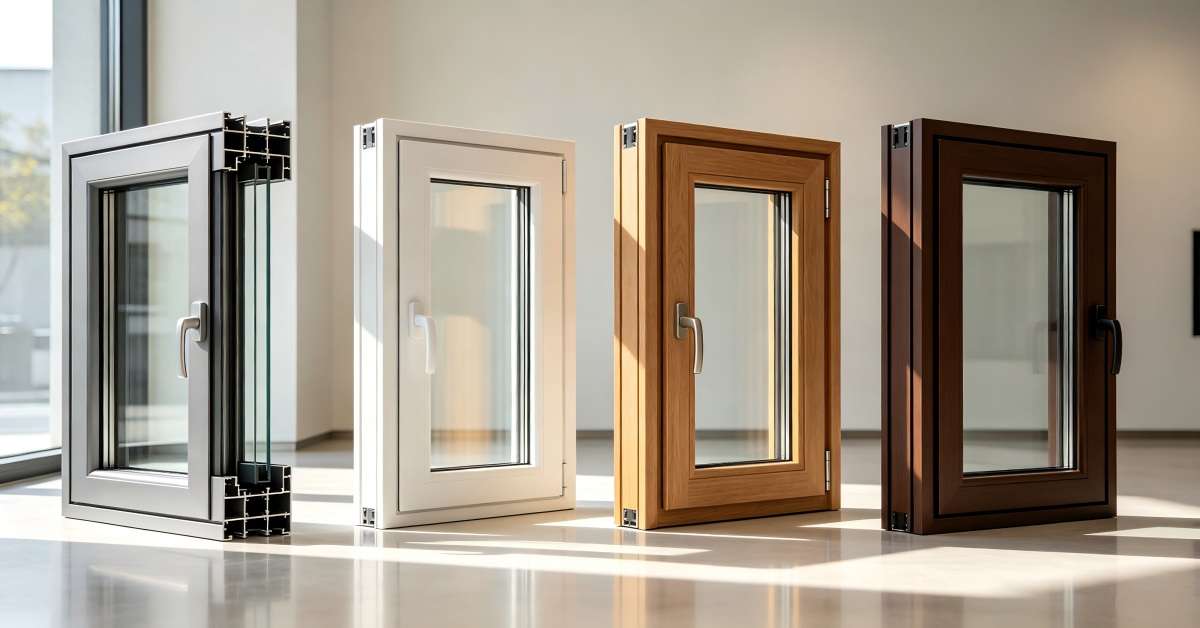
How to Choose the Right Windows? The Ultimate 2026 Buying Guide
How to Choose the Right Windows? The Ultimate 2026 Buying Guide (with Material Comparison & Custom Design)
Reading time: 12 minutes | Last updated: September 2026
Table of Contents
- The Four Main Window Frame Materials — How Do They Differ?
- Thermal Break Technology: The One Thing That Determines Aluminum Window Insulation
- Beyond the Frame: 4 Metrics That Determine Window Performance
- Why Design Matters: Windows Are the Eyes of a Building
- Customization: Make Your Windows Truly Yours
- Choose Windows by Climate — Just Copy This
- How to Tell If a Supplier Is Reliable — 6 Questions to Ask
- Customer Case Study: Residential Project in Vancouver, Canada
- Quick Q&A
- Summary: Four Sentences to Remember
- About Vanlake
You may be choosing windows for a new home, or replacing old ones that leak air. Choose the wrong windows, and you’ll be cold in winter, hot in summer, pay higher energy bills, suffer from noise, and face repairs year after year. In fact, choosing windows isn’t that complicated. Focus on a few key points, and you can avoid 90% of the pitfalls.
If you don’t want to read the full article, just remember these:
- Cold climates: Thermally broken aluminum + triple glazing + Low-E + argon
- Hot climates: Thermally broken aluminum + double glazing + Low-E (low SHGC)
- Budget-limited: uPVC
- Maximum energy efficiency: Fiberglass
- Natural aesthetics: Wood (but requires maintenance)
- Coastal / typhoon zones: Thermally broken aluminum + laminated glass + high water tightness and wind load resistance
But don’t forget: windows are not just functional components — they are the eyes of a building. The same window, well designed, can make a space feel open and stylish; poorly designed, even the best materials won’t help.
Let’s break it down step by step, so you can choose wisely, buy with confidence, and make it beautiful.
1. The Four Main Window Frame Materials — How Do They Differ?
The most common window frame materials are four: aluminum, uPVC, wood, and fiberglass. None is absolutely better than the others — only more or less suitable for your climate, budget, and lifestyle.
1.1 Aluminum Windows
In one sentence: Strong, long-lasting, modern looking — but must be thermally broken to insulate well.
- Pros: Sturdy, durable (50+ years), moisture-resistant, almost maintenance-free, recyclable.
- Cons: Standard aluminum conducts heat very quickly — like a radiator in winter. A thermal barrier is essential.
- Best for: Commercial high-rises, modern residential projects, coastal areas, large glazed openings.
- Design potential: Aluminum allows for slim frames and large glass sizes — ideal for modern minimalist projects. Colors can be customized (powder coating, anodizing, wood grain transfer) to blend perfectly with the building façade.
1.2 uPVC Windows
In one sentence: Affordable, good insulation, no painting — but moderate strength and shorter lifespan.
- Pros: Good thermal insulation, cost-effective, low maintenance.
- Cons: Not as strong as aluminum, thicker profiles (less glass area), may warp over time, lifespan about 25–35 years.
- Best for: Budget-conscious residential projects, mild climates, rental properties.
- Design limitations: Thicker frames mean less open views than aluminum; color choices are also more limited.
1.3 Wood Windows
In one sentence: Best looks, most eco-friendly — but requires regular maintenance.
- Pros: Natural beauty, excellent insulation, lowest carbon footprint.
- Cons: Vulnerable to moisture and sun; must be painted or stained regularly; higher maintenance cost.
- Best for: Villas, historic buildings, projects seeking natural style.
- Design advantages: Unique wood grain, can be carved or shaped — ideal for classic, rustic, and high-end custom projects.
1.4 Fiberglass Windows
In one sentence: Best insulation, most dimensionally stable — but expensive and less available.
- Pros: Very low U-values (0.2–0.3), almost no warping, corrosion-resistant.
- Cons: High price, fewer suppliers, potentially longer lead times.
- Best for: Passive House projects, extreme cold/heat, coastal high-end projects.
- Design characteristics: Cleaner profile lines, mostly standard colors; less custom flexibility than aluminum.
2. Thermal Break Technology: The One Thing That Determines Aluminum Window Insulation
A standard aluminum frame has a thermal conductivity of about 160 W/(m·K) — heat travels through it very fast. Thermal break technology inserts a polyamide thermal barrier (PA66+GF25) in the middle of the aluminum profile. Its thermal conductivity is only 0.3 W/(m·K) — aluminum conducts heat more than 500 times faster.
The wider the thermal barrier, the better the insulation. Compare:
| Frame Type |
Thermal Barrier Width |
Frame U-value (W/m²K) |
| Standard aluminum (no thermal break) |
0 mm |
~5.5 – 6.0 |
| Thermally broken aluminum (standard barrier) |
14.8 mm |
~3.6 |
| Thermally broken aluminum (wide barrier) |
24 mm |
~2.9 |
| Thermally broken aluminum (aerogel barrier) |
Wider |
Down to 1.5 or lower |
More advanced low-lambda thermal barriers (0.21) and aerogel-filled thermal barriers (0.021) can reduce the frame U-value by another 50%, meeting Passive House requirements.
3. Beyond the Frame: 4 Metrics That Determine Window Performance
Don’t be intimidated by technical terms. In plain language:
- U-value (thermal transmittance): Insulation ability. Lower is better. Cold climates: ≤1.5; mild climates: ≤2.5.
- SHGC (solar heat gain coefficient): Sun protection. Hot climates: low (<0.4); cold climates can be higher.
- Air permeability / water tightness / wind load: Weather resistance. Coastal typhoon zones: water tightness at least 450 Pa; wind load Class A7 (2.5 kPa) or higher.
- Acoustic Rw: Quietness. Standard double glazing 30–32 dB; laminated insulating glass 38–42 dB; near airports, 44 dB or higher.
Also check certifications: European CE, North American NAFS, UK UKCA, Australian AS/NZS, South African SANS. Certification doesn’t guarantee the best product, but no certification means higher risk.
4. Why Design Matters: Windows Are the Eyes of a Building
Many people focus only on “how much insulation” or “what wind class” when choosing windows, but overlook one key point: window design directly determines the character of the building and the living experience.
Why design matters
- Daylight and views: A floor-to-ceiling window versus a group of small windows makes a huge difference in openness. Smart division design maximizes natural light and makes spaces feel larger and brighter.
- Façade aesthetics: Windows are a key element of the building façade. Color, proportions, and division patterns directly affect the overall style — modern, classic, industrial, rustic. Windows speak.
- Ventilation and comfort: Opening modes (tilt & turn, sliding, top-hung, casement) affect ventilation efficiency and convenience. Good design allows natural airflow without taking up space.
- Privacy and safety: Glass type (clear, frosted, laminated, Low-E) and opening mode balance daylight, privacy, and safety.
5. Customization: Make Your Windows Truly Yours
Standard-sized windows often cannot perfectly match building openings — especially non-standard projects, renovations, and irregular spaces. Customization solves these problems:
- Non-standard sizes: Whether your opening is 2.4 m or 4.8 m, we can custom-make it.
- Custom colors: RAL color cards, wood grain transfer, dual-color profiles (different inside and outside) to match architectural style.
- Glass configurations: Choose different glass combinations (double, triple, laminated, Low-E, frosted) based on orientation, climate, and privacy needs.
- Opening modes: Tilt & turn, casement, sliding, lift & slide, folding, tilt & slide — customized to your space and habits.
- Special shapes: Curved, circular, triangular, irregular windows — all achievable.
- Hardware choices: Brand, color, function (with lock, with screen, smart opening) — all customizable.
This is Vanlake’s advantage: We don’t just sell windows. We provide one-stop custom service from design, detailing, production, to installation guidance. Whether you are a homeowner, designer, or contractor, we can provide the most suitable window solution for your project.
| Item |
Standard Windows |
Vanlake Custom Windows |
| Size match |
Limited |
Perfect fit to opening |
| Color choices |
3–5 options |
Full RAL range + wood grain |
| Glass configuration |
Fixed options |
Custom combination |
| Opening modes |
Standard |
Any custom mode |
| Design support |
None |
Professional detailing team |
| Installation guidance |
None |
Full drawings + remote support |
6. Choose Windows by Climate — Just Copy This
- Cold climates (Northern Europe, Canada, Northern China): Thermally broken aluminum + triple glazing + Low-E + argon; or fiberglass, aluminum-clad wood.
- Hot climates (Middle East, Southeast Asia, Southern US): Thermally broken aluminum + double glazing + Low-E (low SHGC); uPVC also possible.
- Coastal / tropical: Thermally broken aluminum + powder coating + laminated glass; high water tightness and wind load.
- Temperate / mixed climates: Thermally broken aluminum or uPVC + double glazing + Low-E + argon — best value.
7. How to Tell If a Supplier Is Reliable — 6 Questions to Ask
- Do you have third-party test reports? (Air permeability, water tightness, wind load, U-value)
- What are the exact profile and glass specifications? (Alloy, wall thickness, thermal barrier width, glass build-up)
- What hardware brand do you use? (Siegenia, Roto, etc., corrosion class)
- Have you supplied projects in my region? (Experience matters more than specs)
- Can you customize non-standard sizes and colors? (Key for personalized projects)
- What is your lead time and packaging like?
If they hesitate, or only say “our quality is very good,” find another supplier.
8. Customer Case Study: Residential Project in Vancouver, Canada
Location: Vancouver, Canada
Project type: Detached house, 28 window and door units
Climate challenge: Cold, wet winters with high rain; strict requirements for insulation, water tightness, and wind load
Solution: VLW70 series thermally broken aluminum tilt & turn windows + triple glazing Low-E glass (5Low-E+18Ar+5+18Ar+5)
Performance: Uw ≤ 1.3 W/m²K, water tightness E1200, wind load C5
Client feedback: “After the first winter, indoor temperatures were much more stable, and our energy bill was about 25% lower than our neighbor’s.”
Lead time: 35 days production after drawing approval, shipped to Vancouver, with full installation drawings and remote guidance.
9. Quick Q&A
Q: Are aluminum windows poorly insulated?
A: Standard aluminum windows are, but thermally broken aluminum with good glass and a wide thermal barrier can perform very well.
Q: What windows are best for a Passive House?
A: Fiberglass is best; aluminum-clad wood also works; uPVC may not be sufficient in cold climates.
Q: How long do windows last?
A: Aluminum 50–65 years, wood 56–80 years (with maintenance), uPVC 25–35 years, fiberglass 30–40 years.
Q: Do I need triple glazing?
A: Triple glazing is recommended for cold climates, near busy roads, or airports; double glazing is sufficient in mild climates.
Q: Can I mix different window materials?
A: Yes. For example, aluminum-clad wood combines a weather-resistant exterior with a warm interior. This is common.
Q: Are custom windows very expensive?
A: Not necessarily. Customization can be configured to your needs, avoiding unnecessary waste. With the right supplier, custom can actually be more cost-effective.
10. Summary: Four Sentences to Remember
- Start with climate: Cold → insulation; hot → sun protection; coastal → wind and water resistance.
- Then materials: Aluminum is the most versatile, uPVC the most affordable, wood the most beautiful, fiberglass the most energy-efficient.
- Don’t skip design: Windows are the eyes of a building — division, color, and opening modes all matter.
- For custom, choose Vanlake: Non-standard sizes, special colors, personalized configurations — we make it happen.
Choose the right windows, and you’ll enjoy peace of mind for the next decade or more. If you’re still unsure, send me your project location, budget, and design requirements. The Vanlake team can recommend the right configuration and provide a full custom solution from design to installation guidance.
11. About Vanlake
Beijing Vanlake Engineering Co., Ltd. (Vanlake) is a foreign trade enterprise specializing in architectural aluminum windows, doors, curtain walls, and glass systems. We provide global clients with:
- Aluminum windows and doors (thermally broken, tilt & turn, sliding, folding, tilt & slide, etc.)
- Curtain wall systems (stick and unitized)
- Sunrooms, skylights, and roof glazing systems
- Customization services (non-standard sizes, special colors, irregular shapes)
- Full CE certification, test reports, and technical support
We have supplied projects in North America, Europe, Africa, and Asia for residential, commercial, and hospitality buildings. Whether you are a homeowner, designer, or contractor, we can provide a one-stop solution from design to installation guidance.
Author: Juan Ren, Export Manager at Vanlake, with 10 years of experience in the window and door industry, specializing in custom solutions and technical support for international projects.